
For founder-led coaches, course creators and expert businesses with an offer that already sells.
Twelve months ago, two coaches were doing almost exactly the same numbers.
Twelve months later, one was making three times the revenue from the same ads. Only one thing had changed.
Both selling a $3,000 program. Both running ads to get people onto a list, then onto a call.
Both spent $10,000 a month on ads. Both made about $24,000 back.
Same market. Same price. Same close rate.
If you'd put their two businesses side by side back then, you could not have picked a winner.
Let's call them Tom and Ray.

Month one
Tom spends his $10,000. About 400 people join his list.
Eight of them book a call and buy. $24,000.
The other 392 don't.
Ray does the identical thing. Same spend, same 400 people, same eight buyers. Same 392 who don't.
$24,000.
Nothing separates them. Both are happy with it. Both do it again.
Month 1
Nothing separates them.
Month six
Tom spends his $10,000. Gets his 400 people. Eight buy.
$24,000. Exactly where he was in month one.
Ray spends the same $10,000, gets the same 400 people, and closes the same eight from that group.
But his revenue for that month is $45,000.
Same ads. Same 400 people. Same eight immediate sales. But twenty-one thousand dollars more.
Month 6
Same ads. $21,000 more.
Month twelve
Tom spends the same $10,000. Gets his 400 people. Eight buy.
$24,000. Exactly where he was in month one.
Ray spends the same $10,000, gets the same 400 people, and closes the same eight from that group.
But his revenue for that month is $72,000.
Forty-eight thousand dollars more than Tom.
Month 12
Same ads. $48,000 more.
Tom assumes Ray is outspending him.
He isn't.
Same offer. Same market. Same price. Same close rate. Same ad budget. Three times the revenue.
If both Tom and Ray are still doing the same thing, what is actually happening at Ray's end?
Why is he pulling so far ahead?
It isn't what Tom thinks.
Not the offer. They're near enough identical.
Not the funnel. Same ads, same list, same call.
Not the close rate. Ray's closer isn't better than Tom's.
It comes down to a single number.
4,704
That's how many people found Tom over those twelve months, put their hand up, and didn't buy that week.
He paid for every one of them.
But the problem was...
He barely ever spoke to any of them again.
Ray, on the other hand, reached the same 4,704 people. Same ads, same budget, same funnel.
The difference?
He just didn't throw them away.
He emailed them.
Five short emails a week (sometimes seven).
Every week, for one year.
No new funnel.
No new offer.
Nothing.
Yes...
Just emails.
Daily Emails. The approach made famous by copywriters Ben Settle and Matt Furey.
That's the only visible difference.
And I know exactly how that sounds. Three times the revenue from sending some emails is the kind of claim you'd normally scroll past.
But it's much deeper than that.
It's what the BIG players in this industry understand that the smaller guys like Tom don't.
Here it is.
In any market, the business that can afford to pay the most for a customer wins.
You've probably heard this quote before.
The business that can pay the most to acquire a customer wins.
Most people hear that and think deeper pockets.
It isn't.
It is knowing what every acquired lead becomes worth over time.
That is what lets someone outbid everyone for the traffic, take placements nobody else can afford and break even on the first sale while everyone else fights to stay profitable on day one.
So the real question was never "Should I send more emails?"
It's this.
How much can you afford to pay for a customer?
And that number has nothing to do with your ad account. It is decided by how much value each acquired lead produces over the full lifetime of the relationship.
Which is exactly where Tom and Ray split.
Take one month and follow it.
January, one year ago. You already know the numbers.
$10,000 in ads, 400 people, eight buy. Which leaves the 392 who raised their hand and didn't.
Here's what happened to those 392.
Tom moves on to February, which is the normal thing to do. Those 392 didn't convert. Time to go and find some more. They'll get a promo when the next launch comes round, and otherwise they sit there.
Ray emails them. Every weekday, whether or not he has anything to sell.
Over the next eleven months, sixteen more of those 392 buy.
Not because he wore them down. Because they weren't ready in January, and they got ready in March, in July, in December. And when they did, Ray was the one still in the conversation.
The other 392 never hear from him again.
He emailed the other 392. Sixteen more bought.
Tom got 8 customers out of January. Ray got 24.
Where did Ray's extra sixteen come from? Not from better ads. He didn't run any. Not from a better funnel. It was the same one.
They came out of the pile Tom threw away.
Then it happens again to February's 392. And March's. That's why the gap kept widening while nothing visible changed. Tom was working one month at a time. Ray had a year of cohorts stacked up and still converting.
So what's a customer actually costing each of them?
Tom paid $10,000 for eight. That's $1,250 a customer.
Ray paid $10,000 for twenty-four. That's $417.
Here's what that does to Tom, and he still doesn't know it's happening.
A lead costs them both about $25. But Ray's leads are worth three times more to him because his system produces twenty-four customers from January's 400 instead of eight.
So Ray can pay $75 a lead. Three times what Tom pays. And he still lands at exactly the $1,250 per customer Tom is paying right now.
Same auction. Same audience.
If Ray uses that advantage, Tom cannot follow. His costs climb, his margins thin, and what looks like another expensive quarter is partly the result of bidding against someone who can afford three times what he can.
And that's the whole thing.
Ray isn't a better marketer than Tom. He's not smarter, he doesn't work harder, and he isn't running better ads.
He can just afford more than Tom can.
Because he stopped throwing away the people who weren't ready yet.
The cost of settling for average
Here's the thing about Tom. He was never in trouble.
Every month he was profitable.
Every month the funnel worked.
Nothing ever broke badly enough to force him to look at it. Ask him at any point in that year how business was, and he'd have said yeah, decent.
So what did one decent year actually cost him?
About $288,000.
That's the gap between what he made and what Ray made, on the same offer, in the same market, from the same ads.
And this is the part I'd sit with if I were him.
He paid for those people too.
Tom didn't miss an opportunity he never had. He bought the same 400 every month, out of his own budget, and let them go cold. He financed the whole thing and collected only the ready-now sales.
Almost three hundred thousand dollars, decided by nothing more dramatic than we'll email them when there's a launch.
It never showed up on a report either. There's no line in any dashboard called "revenue we already paid for and didn't collect." It just quietly wasn't there, month after month, while everything looked fine.
Email was the tool. The real advantage was the relationship.
Ray's emails are the visible difference between the two businesses.
But the emails themselves are not where the value came from.
The value came from what they allowed him to keep.
Tom paid to meet someone, gave him one short window to buy, then treated the relationship as finished.
Ray paid to meet the same person and deepened that relationship after the campaign ended.
That changed what every acquired lead could become worth over its full lifetime.
And to be precise, the $288,000 above only counts more non-buyers eventually making a first purchase. It does not count renewals, upsells, repeat purchases or anything those customers may buy later.
The relationship advantage could continue after the first sale too. None of that is needed for the math you just read.
Direct response gets people through the door. It turns attention into an opt-in, a booked call or a first purchase.
But the first funnel is only the beginning of what that relationship can produce.
The businesses that become difficult to compete with understand this.
They do not judge an acquired person only by what he pays this week. They build the brand, trust and familiarity that let the relationship keep producing value for months or years.
That is why they can spend more to acquire attention in the first place.
The economics are downstream of the relationship.
The market psychology behind why this works
At any given moment, only a small part of a suitable market is ready to make a decision.
The rest are still researching. Comparing approaches. Working out whether they trust you. Recovering from the last thing they bought. Waiting for the problem to become painful enough. Or simply dealing with something more urgent this month.
This is often illustrated with the Larger Market Formula.
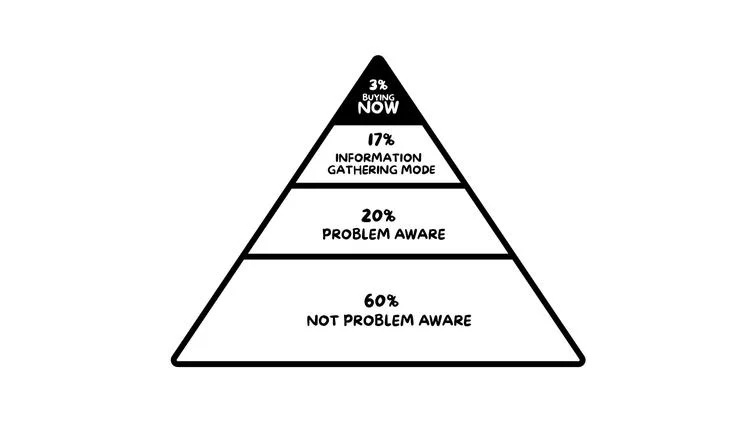
Your marketing reaches people at every level of that pyramid.
Your sales process naturally converts more of the small group ready to act today.
You should still improve the front end.
Write better ads. Make the webinar clearer. Tighten the VSL. Improve the sales page. Train the closer.
All of it matters.
But there is no funnel that makes every qualified person ready on the same Tuesday.
A deadline can give someone a reason to decide sooner, but it can't answer every unanswered question, undo every bad experience or make his circumstances change on command.
When the promotion ends, that unfinished thinking does not disappear.
It either continues with you, continues alone, or continues with somebody else.
Email is how you get them towards "readiness" (with you).
For an expert business, email is about as close to a perfect relationship channel as it gets.
It is direct. It is owned. It is inexpensive to send. It can feel personal at scale. And unlike a social post, it does not disappear because an algorithm decided not to show it.
But getting someone ready to buy is not enough.
You need to make them ready to buy FROM YOU.
Because while you are quiet, your competitors are still in their inbox.
They are answering questions, becoming familiar and giving their explanation for why the problem exists and how it should be solved.
The truth is that Tom and Ray may promise similar outcomes. Their frameworks may even share some of the same steps.
What creates preference is not a destination nobody has heard of before. It is a distinct and credible route to that destination.
Ray uses email to make that route familiar.
He gives useful help before anybody buys. He tells personal stories that reveal how he thinks. He shares the philosophy behind the work, names the mistakes he sees everyone else making and connects those ideas back to the unique mechanism behind his offer.
That mechanism gives the prospect a reason to believe Ray's approach is different, more credible and better suited to him.
Email lets the argument build one piece at a time.
One email answers an objection. Another explains why the old approach keeps failing. Another tells a story. Another demonstrates the mechanism. Another makes an offer when the problem becomes urgent.
No single email needs to do everything.
Over time, the prospect understands what Ray believes, how his method works and why it may be the right way to solve the problem.
That creates trust and, more importantly, preference.
This matters even more when AI can give anyone unlimited information in seconds.
The winner is not automatically the person who teaches the most. It is the person who can be useful, entertaining and recognizably human while making a distinct way of thinking familiar.
Information can be copied. A relationship with a personality and philosophy is much harder to replace.
Email does not merely make the prospect ready to buy. It helps make him ready to buy from Ray.
The relationship does the work across time.
And this is where it compounds.
Compound interest is the eighth wonder of the world.
The point is that yesterday's gains begin producing gains of their own.
January's non-buyers do not vanish when February's subscribers arrive. February stacks on top of January. March stacks on top of both.
The audience knows you better. The offers become more familiar. The objections become clearer.
Each month begins with more relationships and more information than the month before.
Tom resets to zero.
Ray starts from everything he has already built.
That is how the gap becomes $288,000 without one dramatic breakthrough.
It is also how a business starts behaving like the player it wants to become.
Not by chasing a new trick every quarter, but by building a system where every dollar and every hour spent acquiring attention keeps working longer.
So why isn't everyone doing this?
Because knowing email matters and operating it every week are completely different things.
You've probably tried.
Week one. You write three emails and they're good.
Week two. You get two out.
Week three. You're writing Thursday's email at eleven at night because it was last on the list and you've run out of things to say.
Week five. There isn't one.
Then a few months of silence, a small wince every time you see the subscriber count, and eventually another attempt.
There is a quieter reason it keeps happening too.
You cannot see what email is worth.
You have a feeling it contributes. Revenue is coming in and some of it must be email.
But if I asked what email earned last month, you would probably give me an impression rather than a figure.
That creates a loop.
Email does not receive proper resources because nobody can prove what it is worth.
And nobody can prove what it is worth because nobody owns it closely enough to measure it.
So it remains a maybe at the bottom of the list for another year.
It was never a discipline problem.
Daily email is not one task you failed to keep up with.
It is a complete operating function you were trying to run in the margins of another job.
Someone has to develop the ideas, research them, write the emails, load them, send them and make the offers.
Someone has to protect deliverability, manage the list, watch complaints, segment subscribers and make sure the emails arrive.
Someone has to build the automations that handle the moments broadcasts cannot.
And someone has to connect the work to revenue, learn from it and decide what should happen next.
All of it runs every week.
The surprising part is not that you stopped.
It is that you kept it going for five weeks.
This is not a knowledge problem.
It is an ownership problem.
Scientific Email Persuasion™
This is the system I run to own that function for you.
Four connected parts, operated by one person and informed by everything the system learns.
1. Deliverability. None of this matters if they don't see it.
Here is a question most founders cannot answer.
When you send an email, where does it land?
Not the open rate. The actual destination.
Primary inbox, Promotions or spam.
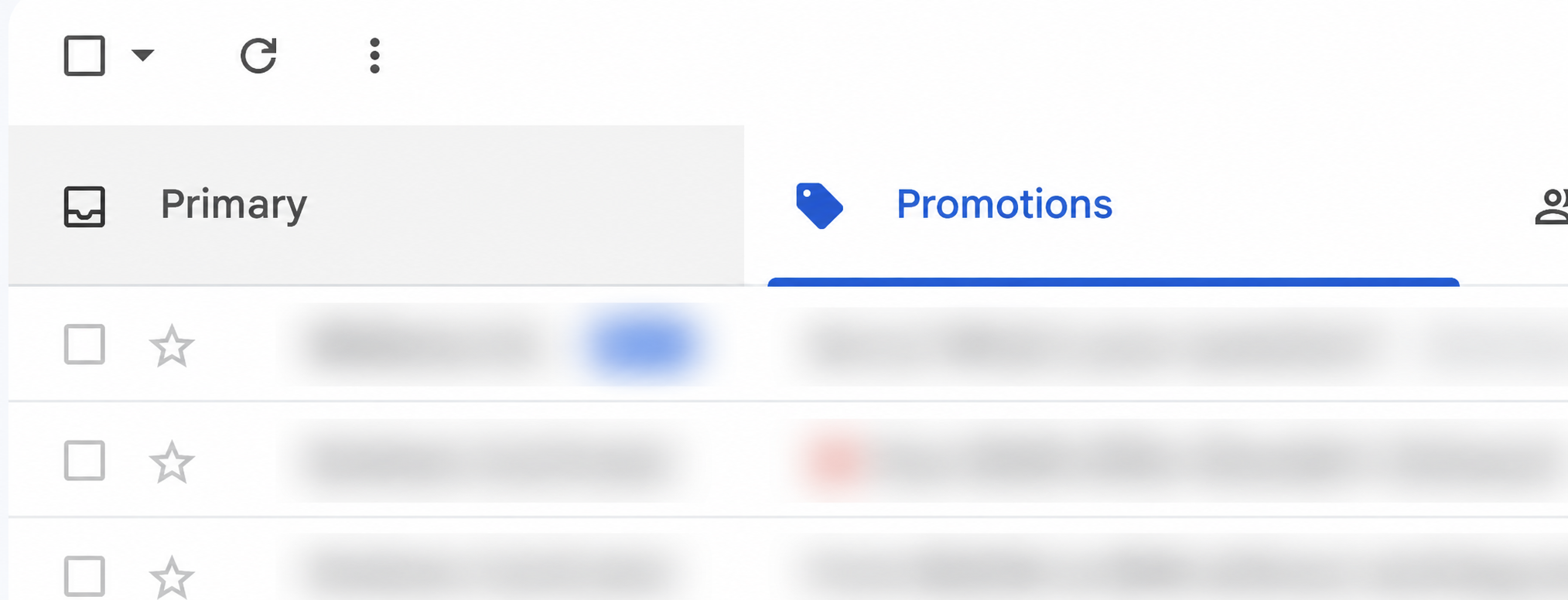
Sender records, domain reputation, complaint rates, bounces and unhealthy segments all influence whether the relationship gets a chance to exist.
So we begin with an audit, fix what can be fixed now, create a safe plan for what takes longer, then keep monitoring it.
If the list has been quiet, it receives a careful restart rather than a sudden flood of email.
2. Daily Emails. This is the engine.
Approximately five emails per week (can be seven at times), researched, written, loaded and sent.
Each one has a job.
Make your mechanism familiar. Answer an objection. Shift a belief. Tell a story. Demonstrate expertise. Reveal personality. Present an offer.
The goal is not to hammer the same pitch into someone's inbox until he gives up.
It is to become familiar, credible and useful enough that when the timing changes, the decision becomes easier.
What this buys you: by the time someone is ready to spend, he understands how you think, what you believe and why your approach is different from what he already tried.
You'll be the first in his mind when he becomes ready.
3. Automations for the moments a broadcast cannot catch.
A broadcast speaks to the list on the same day.
But subscribers arrive and act at different moments.
A new subscriber needs a proper introduction.
Someone considering an offer may need preparation, reminders or follow-up.
A booked call needs confirmation and a no-show path.
A customer needs onboarding and should stop receiving pitches for the thing he already owns.
We map those moments across your funnel and build the most valuable sequence first, then continue improving the system each month.
A few examples of automation sequences are:
- Welcome sequences (when someone opts in from your site or downloads a lead magnet)
- Pre-call sequences when someone books a sales call
- Post-call sequences when someone finishes the sales call without buying
- Pre-webinar sequences to increase show rates
- Post-webinar sequences for no-shows
- Post-webinar sequences for non-buyers who attended
- Consumption sequences for buyers of your front-end product (to help them consume it and eventually lead to an appropriate higher-ticket offer)
- More sequences we can add based on your funnel setup
Within the sequences themselves, there's plenty of Hollywood-style storytelling and belief-shifting work we can do. Daily emails are only part of the sauce that makes the system work.
4. AI Second Brain (The learning loop).
Most email programs forget everything they learn.
A writer sends copy. The campaign ends. A few numbers sit in the platform, disconnected from the words that produced them, and the next campaign begins from another guess.
This one does not.
Your emails, results, offers, stories and audience responses build into one client-specific record.
Each month we look at what actually happened.
Which stories held attention. Which arguments moved people toward a call. Which offers landed. Where the expected action broke down. What deserves repeating and what should be dropped.
An observation becomes a test. A result that holds up becomes part of how we write for you. Sometimes it becomes an automation that runs for years.
So month six is informed by everything the first five months taught us about your audience and nobody else's.
Every email we send is tracked in a dashboard.
That data feeds an AI-assisted system that helps us surface patterns unique to your business and improve the program over time.
That includes which stories resonate, which arguments move people toward a call and which ideas deserve another test.
Together, this forms an "AI Second Brain."
And the loop from earlier finally closes.
Email stops being a maybe and becomes a line you can defend.
"Okay... So I'll hire a copywriter to do it (or use my existing one)."
Hiring a copywriter is better than doing nothing.
But the writer usually writes and hands the document back.
Someone still has to load it, schedule it, manage the list, watch delivery, build the automations, connect results to revenue and decide what should happen next.
That someone is still you, or the marketer you already overloaded.
A VA can execute a checklist, but somebody must create the strategy and know when the checklist is no longer the right one.
AI can produce drafts, but somebody must decide which idea is worth sending, whether it sounds like you and what the result means.
Each partial fix solves a piece and returns ownership of the rest.
There is another problem with buying isolated copy.
A copywriter who cannot see the data does not get better.
He writes. It goes out. Nothing specific comes back.
So in month six he is writing from the same understanding he had in month one.
I know this because I spent years on the receiving end of it.
I would write something I was proud of, hand it over, then hear nothing useful.
Did people open it? Did they click? Did it sell anything? Did it land in Promotions and die on a Tuesday?
I rarely knew.
So the next email was another guess wearing the costume of a decision.
That is a miserable way to write and an expensive way to buy copy.
There is a difference between buying emails and having the channel run.
"But my list is personal. I want to write it myself."
That is a fair objection.
Your list is where people hear how you actually think, not how a brand guide says you should sound.
Handing it over is not the same as handing over your ad account.
So I am not replacing your thinking.
Your thinking was never the bottleneck.
It already exists in your calls, content, stories, client work and the thing you said last Tuesday that made the problem click for somebody.
My job is to find it, understand it and turn it into communication that reaches the market consistently.
We begin with a deep Creative Brief covering your beliefs, voice, stories, offers, market, mechanism and constraints.
Then we speak twice a month, with Slack or WhatsApp between calls when an idea appears at half nine at night.
Most of the best material will come from something you said without realizing it was an email.
I have been working that way for years.
Here's one of my old newsletters, which explains part of my process.
A real story, with a commercial point
Published 12 December 2022. Recreated in an email layout, not an inbox capture. Ellipses mark cuts.
Solomon De Leon Why I Wine and Dine With Clients To Produce More Mula Emails 💰
About a week ago I met up with one of the more successful business strategy consultants here in Singapore
He is a mentor to one of my clients and I joined them for a whole day of planning
After an intense workday, we went down to grab some Wagyu beef for dinner
That bowl of Wagyu took me 15mins to finish but we stayed at the restaurant conversing for more than 2 hours
…
I relived the stories he was sharing and took mental notes of the unique perspectives he held
After the walk, went back to my laptop, and… BAM!
…
Someone who wants to hear you out—your stories, your perspectives, and your worldview
And more importantly, someone who’s skilled enough to pick up the right insights from those conversations and seamlessly weave them into your emails
Two hours over dinner gave me material I could write from for months.
Your calls do the same thing.
I am a ghostwriter and an operator. A pen for your ideas, with responsibility for what happens after the writing.
The thinking stays yours.
I make sure it reaches people's inboxes consistently.
And you approve what goes out until you stop wanting to.
"Couldn't AI just do this?"
If you have built something that produces emails you are proud to send and a system that runs the rest, use it.
I mean that.
But most founders have already tried.
The writing was competent. It just did not sound like them, so they rewrote it and saved no time, or sent it and felt slightly wrong about it all day.
I use AI constantly for research, memory, analysis and finding patterns across results.
It is part of how one person can operate this much context.
But someone still needs to know which idea deserves building, which story earns the space, what sounds generic and what the data can honestly support.
AI makes a good writer faster. It does not make writing good.
Hi, I'm Solomon.

I have spent years writing emails, ads, sales letters and VSLs, and I have also been on the other side of the funnel taking sales calls and running demos.
I build the systems around the writing too, so I think about what happens before the email and after the click, not only the words in between.
My mentor was Kenneth Yu, formerly Mindvalley's Chief Copywriter.
I trained through Peter Kell, Derek Johanson and Kyle Milligan, and studied Gary Halbert, Joseph Sugarman and Eugene Schwartz closely enough to steal properly.
If you want to see how I think rather than how I write for other people, I publish on Substack.
What you actually get.
Onboarding
- Deliverability and list-health audit.
- Creative Brief and voice-extraction process.
- Review of your offer, funnel, existing emails, automations and available performance data.
- Agreement on the commercial baseline, attribution model and reporting source.
Every month
- Twenty-five persuasive emails, sent approximately five times per week.
- One new automation sequence or a meaningful rebuild of an existing sequence.
- Ongoing testing, list cleaning, segmentation and deliverability monitoring.
- Two calls for ideas, reporting and strategy, plus Slack or WhatsApp access.
- Email revenue reporting and a monthly review of what should happen next.
- A client-specific body of learning that improves future broadcasts and automations.
You provide access, expertise and timely feedback.
You do not need to arrive with a month of email ideas.
What a few more customers are worth.
Say your program is $3,000 and one in five booked calls becomes a customer.
Two more customers a month is $6,000.
That requires ten additional booked calls from an audience containing thousands of people who already raised a hand once.
Same close rate, same price.
$6,000 becomes $12,000 in monthly first-sale revenue.
The math is bookings multiplied by the share of those bookings that become customers multiplied by the average initial sale value.
That close rate counts every booking, including no-shows.
This is a scenario, not a forecast. More emails do not automatically create more calls, and your costs still come out of the result.
It also excludes renewals, upsells, repeat purchases and lifetime value.
We would run the real numbers on the call.
I am looking for situations where my fee is a fraction of a credible opportunity.
Explore your email revenue opportunity
Enter your own numbers, then use the suggestions or type your own to compare today with a daily-email scenario. Nothing here is a benchmark or a promised result.
One shared price for both columns below.
Calls booked from email per month
Double today's 10. Five emails a week gives more of your list a reason to book.
Share of calls that become customers
5 points higher. People who've read weeks of your emails arrive already understanding your method.
+$6,000 extra revenue a month
10 → 20 calls · 2 → 4 customers
Scenario updated. Additional monthly revenue: +$6,000.
Revenue before expenses, not profit or ROI. Results may include fractional expected customers because this is a mathematical scenario, not a promise of individual sales.
The Fee-Back Guarantee
You do not lose money on my management fees. That is the deal.
If the extra email revenue we agree to count over the first sixty days comes in below what you paid me in management fees for that period, I refund the shortfall up to those fees.
Nothing counted means the management fees come back in full.
You keep the sales, emails, automations, deliverability work and reporting setup regardless.
There is a check before that too.
The first fourteen days are a viability window.
If I inspect the setup and find a technical, tracking, offer, compliance or sales-process problem I cannot responsibly work around, I end the engagement and refund the management fees.
You still keep the completed client-facing work.
Before anything begins, we agree in writing on the baseline, attribution rules, reporting source and what counts as eligible collected email revenue after refunds and chargebacks.
We also agree on your responsibilities, including access, approvals, a working offer and funnel, calendar capacity and reasonable sales follow-up.
I do not expect to write that refund.
If we work together, it is because I have looked at the list, offer and numbers and found substantially more opportunity than my fee.
The guarantee means you do not need to rely on that judgment before seeing the work operate.
We will review the written terms together before you commit to anything.
Who this is for.
The guarantee only works if I am selective.
- A proven, high-margin offer that already sells. Email will not rescue a weak offer.
- An audience and a reliable paid-acquisition engine adding to it.
- Enough room to serve additional customers. More sales are not helpful if fulfillment is already full.
- Access and agreement on measurement. ESP, checkout, CRM, calendar and relevant tracking.
- A functioning sales process. I can help fill the calendar; I cannot sit in the sales seat.
- Timely feedback. Two calls each month and answers when the work needs them.
- A long view. The system is least informed in month one and most valuable after it has accumulated real market learning.
If you are still validating an offer or building an audience from zero, this is not your bottleneck.
And if you only want to test whether email is worth bothering with, you would be buying the least valuable version of what I do.
I can only take on three businesses at a time.
The Suasion is not a traditional agency.
There is no account manager and no junior writer learning on your list.
I hold your market, offer, voice, stories and results directly, which requires real attention.
I take on no more than three active email-management clients at once.
When those slots are filled, new work waits.
We will cover current availability on the call rather than inventing urgency on this page.
What the call actually is.
On the call, we diagnose what happens after somebody enters your funnel and does not buy immediately.
We will look at what you pay to acquire attention, what happens to non-buyers after the campaign ends, how email currently supports the sales process and whether the economics justify changing it.
Then we work out where relationships are being lost, what would need to change and whether I am the right person to operate it.
If there is a fit, we will discuss working together.
If there is not, you will leave knowing where the relationship and revenue system is breaking.
Bring whatever numbers you have.
Talk soon,
Solomon
P.S. You already paid for those leads. The money has already left your account. The only question is whether the relationships you bought are still working for you, or quietly expiring while you pay to acquire replacements.